Will structured data enhance visibility in AI search? Practical approaches to avoid confusing SEO and AI search

July 24, 2026
|
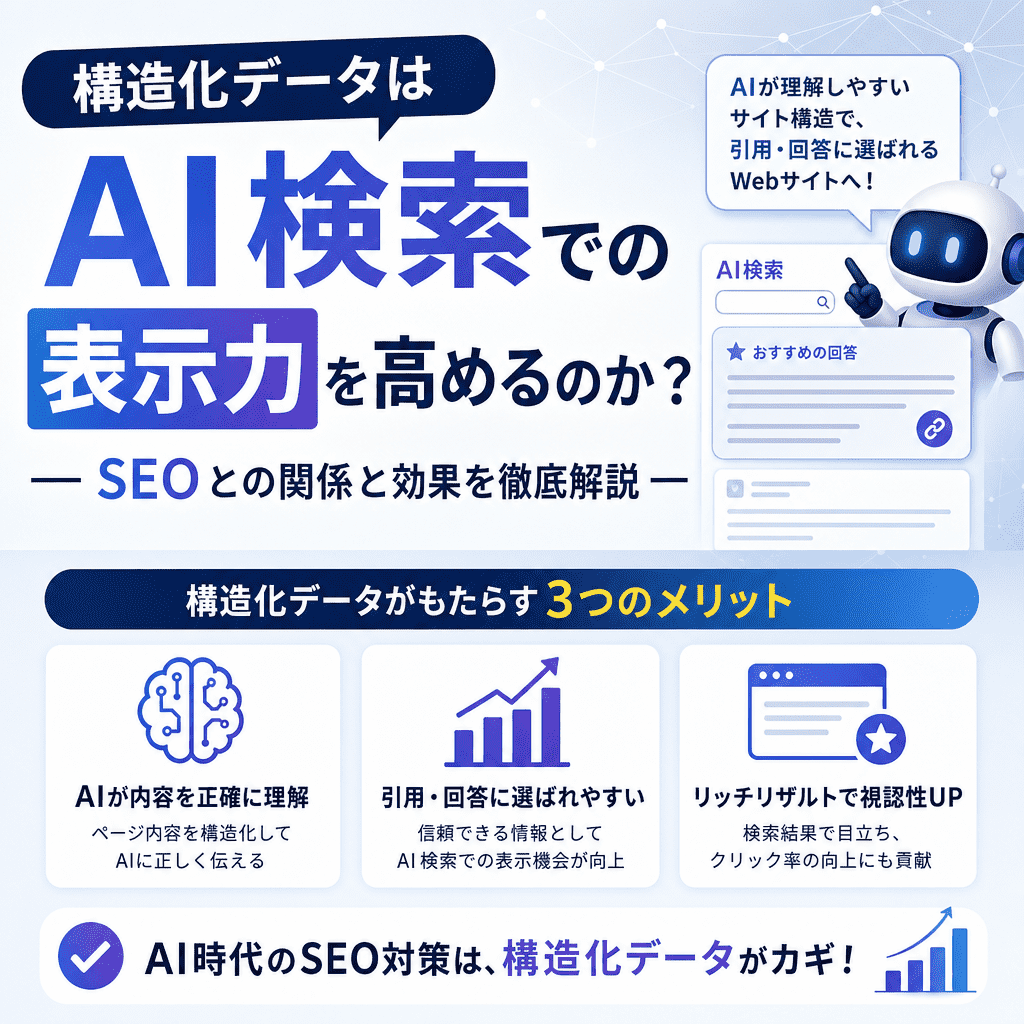
Japanese infographic explaining structured data in AI search and SEO. It uses text, computer icons, search boxes, graphs, and charts to illustrate the importance of structured data in improving AI search results and optimizing user experience.

Table of Contents

On-page SEO is still necessary. However, the view that "Google doesn't evaluate on-page optimization because rich results are no longer as common" is a bit off the mark.

It is particularly easy to confuse Structured Data, Rich Snippets, and Visibility in AI Search They are related, but not the same.

In conclusion, I do not believe that structured data directly increases visibility in AI search. However, well-designed schema can be a factor that strengthens the relevance of a page. If you don't understand this difference, you'll end up implementing ineffective measures like just adding more schema for AI purposes.

First, on-page SEO and rich snippets are separate matters

The purpose of on-page SEO is not simply to display rich snippets such as star ratings or FAQs in search results. The essence is to clarify what the page is about and to prepare it so that search engines can easily understand the content.

Rich snippets can sometimes be generated by structured data. Structured data is a description that clarifies information within a page for search engines. It supplements information that might be ambiguous in regular body text written for humans, in a format that machines can easily interpret.

For example, for a local business page, you can structure and convey information like this:

  • legalName
  • Location
  • Supported areas
  • Services Offered
  • openingHours
  • Association with external profiles and official pages

However, it is not the case that rich snippets will absolutely not appear without structured data. If a page is properly formatted, the HTML is well-structured, and the hierarchy of headings and information is clear, search engines may understand the content from the page body and lead to featured snippets.

In other words, Rich snippets are the result of the overall structure and quality of the page, not just schema is what it means.

Search engines and AI models do not handle information in the same way

The most important thing to consider with AI search is not to equate traditional search engines with AI language models. They differ in how they retrieve and return information.

Google Search returns pages

Traditional search engines, in response to a query, provide highly relevant Page is returned as a search result. Therefore, it is necessary to understand the theme, quality, structure, links, entities, and technical implementation of the page as a whole.

Structured data originally developed as a common language to convey to search engines what a page is about. It is an auxiliary layer for explaining human-readable text more clearly to algorithms.

AI models handle relevant sections and chunks

On the other hand, AI language models do not necessarily treat the entire page as a single search result. For a question, the relevant part, section, chunk and constructs an answer based on it.

This difference is important. Just because you implement structured data for AI search does not mean that AI models will treat that markup specially, in the same way that search engines evaluate schemas.

Does structured data directly affect visibility in AI search?

There are two main ways of thinking about this topic.

  • The idea that structured data is also effective for display in AI search
  • The idea that AI models don't use schema as a special signal, so there's no direct effect

My view is closer to the latter. At least, we cannot simply state that structured data itself directly enhances visibility in AI search.

When AI models crawl or ingest a page, they naturally treat large blocks of structured data not as "this is a special SEO signal," but similarly to other content on the page token It's possible to ingest it

In other words, what's important for AI is not the label schema itself, but the words, entities, context, and relationships contained within it.

An infographic in Japanese titled "Enhancing Visibility in AI Search." Using blue, white, and purple colors, with icons and robot illustrations, it explains the benefits of structured data for AI search, SEO, and online visibility.

What you should really look at is token and entity density

This is the practical value of structured data.

Well-optimized structured data contains information related to the page's theme, such as the business, services, region, categories, and related organizations. If AI models ingest these as regular tokens, it increases the amount of relevant information present on the page.

This is because the page's Entity density or strengthening thematic consistency.

For example, in the LocalBusiness schema for local businesses, the following properties can be used to reinforce relevance:

  • sameAs : Link to URLs containing accurate information about the business, such as official social media or trusted external profiles
  • areaServed : Specify the municipalities or areas that fall under the service area
  • Information about services and products : Clarify what kind of business it is
  • Information about the location : Reinforces connection with the target region

All of these serve as clues to relevance regarding combinations of products, services, locations, and businesses. Even if AI doesn't interpret schema as a special structure, the relevant tokens contained within can enrich the meaning of the page.

Correct understanding of "schema works"

Even if structured data contributes to AI search, it does so in the following ways Indirect effect It's natural to think of it

  1. Clarify entities related to the page's subject
  2. Supplement the relationship between services, regions, brands, and external references
  3. Add relevant tokens to the page
  4. As a result, it can help analyze the relevance of the entire page

The important thing is that this is not a story about "if you include JSON-LD, you will rank high in AI search."

Schema is not a magical ranking signal. The core of AI search optimization should be content that clearly answers questions, an organized heading structure, accurate entity information, and a specialized page design. Structured data should be used to reinforce that foundation.

Why you shouldn't stop doing on-page SEO even in the AI era

Even if the frequency of rich snippet display or the appearance of search results changes, the value of on-page SEO does not disappear. Rather, the importance of the fundamentals is increasing to make pages understandable to multiple information retrieval systems, including AI search.

In practice, it's good to consider the following priorities.

  • First, create a page that is useful and clear for humans
  • Structure headings, body text, and HTML to make the page's meaning easier to understand
  • Do not obscure important entities such as services, regions, and brands
  • Implement structured data to the extent necessary and ensure information consistency
  • Do not judge the success or failure of measures solely by the presence or absence of rich snippets

Structured data is still useful for traditional SEO. And in the context of AI search, it can also have value in reinforcing relevant information.

Summary: Structured data is not a direct AI measure, but an element that reinforces relevance

AI models and search engines are not the same thing, and they retrieve information differently. Google Search focuses on understanding pages, while AI models handle relevant sections or chunks for a question.

That's why structured data should not be overestimated as a direct measure to improve visibility in AI search. On the other hand, schema that appropriately includes information about entities, regions, services, and external references can reinforce the relevance of the page.

The most realistic approach is simple. The goal is not structured data itself, but to consistently clarify who the page is, what it offers, where it is related, and what questions it answers. Use schema as a supplement for this. This is a solid approach that works for both traditional SEO and AI search.

The AI Era SEO is GEO to.

Register for free and we will translate your site into your desired language.
Up to 10,000 words are free, so If it's a small site Within the free limit We can fully accommodate you. Please feel free to use it.

2026 will be the year AI models cite you as a success. will be the key. Register for free today and Get ahead of the competition and start with multilingual SEO.
An abstract blue geometric logo on a light gray background, composed of angular shapes and lines, reminiscent of a stylized fox or wolf head. Ideal for a modern interface management menu icon.
VERBARANK
Multilingual SEO & GEO Platform for the AI Era. Structure content in over 120 languages and build websites cited by major AI models like ChatGPT, Gemini, and Claude.
Copyright © 2026 VERBARANK. All Rights Reserved.