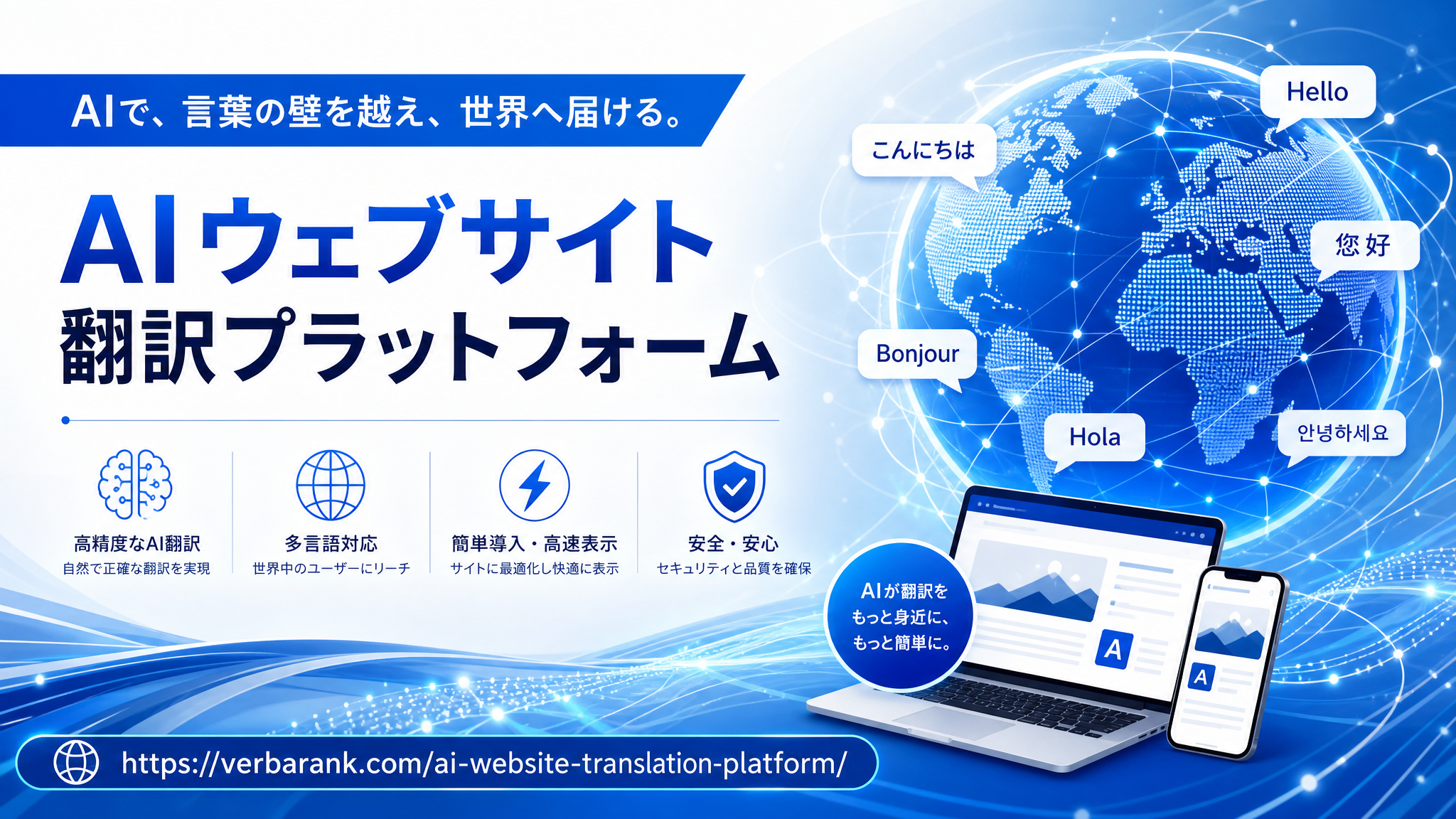
Many people want to make their websites multilingual but hesitate to take the first step due to the need for coding knowledge or low translation accuracy. VERBARANK is an AI website translation platform that solves these challenges all at once. It supports over 120 languages and can be implemented in as little as 15 minutes. It automatically optimizes not only for high rankings in Google search but also for structures that are easily cited by major AI models such as ChatGPT and Gemini.
VERBARANK is a next-generation platform that simultaneously achieves multilingual SEO and GEO (Generation Engine Optimization). Traditional translation tools could only 'convert words to another language.' VERBARANK, while maintaining translation accuracy, automatically builds content structures optimized for both search engines and AI models.
A key feature of VERBARANK is its ability to format content into a structure that is easily cited by the seven major AI models: Claude, Gemini, ChatGPT, Grok, Meta AI, DeepSeek, and Perplexity. For companies and individuals looking to grow their business in the global market, there are few other platforms that can handle both SEO and GEO simultaneously. The ease of implementation without the need for coding is also one of the reasons why it is supported by many users.
A website in Japanese alone is virtually non-existent to overseas users. Approximately 60% of content on the internet is written in English, while Japanese content accounts for only about 3% (W3Techs, 2026). This means that sites publishing only in Japanese are missing out on the majority of global search traffic.
Having a multilingual website not only increases search traffic from overseas users but also greatly expands the opportunities for your content to be cited by AI models. Since generative AI tends to prioritize referencing content in its native language, having pages optimized in languages such as English, Spanish, and Arabic is a direct means to enhance global visibility. Utilizing a multilingual SEO platform is no longer an option; it is the foundation of global business.
Google's AI Overviews prioritize content that matches the user's search language. Users searching in English will see English content cited, while users searching in French will see French content cited. Generative AIs like ChatGPT and Perplexity also tend to generate answers from content closest to the language used in the query.
In other words, if you don't have content in the target market's language, no matter how good the information you provide, it won't reach the AI search engines in that market. Multilingual GEO targeting is the most reliable way to reach users in each language region.
Machine translation tools convert words, but they cannot optimize metadata required for SEO or structure content required for GEO. For example, even if you post text translated by Google Translate as is, Google cannot correctly index the page if the hreflang tag settings and language-specific URL structure are not in place.
VERBARANK's neural translation engine achieves a translation accuracy score of 90%, generating natural translations that understand context. By organizing SEO and GEO structures simultaneously with translation, the key difference is that it allows you to create content optimized for both search and AI all at once, rather than just automatic multilingual website translation.
VERBARANK consolidates all the functions necessary for multilingualization into a single platform. The main functions are introduced below.
VERBARANK's neural translation engine understands the entire context of a sentence to translate, rather than just replacing words. It supports over 120 languages, including English, Spanish, Chinese, Arabic, and French. It generates natural translations while maintaining the brand's tone and voice, avoiding the unnaturalness characteristic of machine translation.
The accuracy of AI translation is high compared to the industry average, with a translation accuracy score of 90% being an important standard for maintaining content reliability. Even for technical or medical content with many specialized terms, accurate translations that take context into account are possible. This level of translation accuracy forms the foundation for building a multilingual site with global SEO in mind.
VERBARANK automatically structures content to be easily cited by the seven major AI models: Claude, Gemini, ChatGPT, Grok, Meta AI, DeepSeek, and Perplexity. It analyzes the preferred content format for each AI model when generating answers and optimizes accordingly.
Specifically, we structure sections as independent units of information, creating a format that AI can cite without context. Question-style headings, clear definitions, and the natural insertion of numerical data are points that are evaluated as content for AI model citation. GEO optimization tools that can apply generative engine optimization to the entire site are extremely rare at present.
You can implement VERBARANK in 4 steps, even without technical knowledge. No HTML or CSS knowledge is required, and you don't need to prepare dedicated engineers. Small and medium-sized business owners and individual bloggers can start multilingual support immediately.
The speed from implementation to launch in as little as 15 minutes is overwhelmingly shorter compared to traditional multilingual projects. Typically, building a multilingual site can take anywhere from several weeks to several months. The no-code multilingualization mechanism significantly shortens this process.
Implementing VERBARANK is completed in a simple 4-step process that anyone can follow without confusion. You can convert your existing site into a multilingual, AI-optimized site as is.
The first step is to connect your existing website to VERBARANK. No coding is required; simply enter your site's URL to complete the connection. It supports major CMS like WordPress and Shopify, as well as custom-built sites.
After connecting, select the language you want to translate from over 120 languages. You can narrow down the languages according to your business target regions, allowing for flexible settings such as choosing Chinese, Korean, and Thai for the Asia-Pacific market. Since target regions can be specified in detail for each language, it becomes easier to create a global SEO multilingual strategy specialized for each region.
Setting the language automatically starts VERBARANK's neural translation engine. While generating content for each language with a translation accuracy score of 90%, it simultaneously automates the setup of hreflang tags, structuring of language-specific URLs, optimization of translated metadata, and preparation of GEO-appropriate content structure. There is absolutely no need for manual setup of these SEO technical requirements.
The final step is publication. In as little as 15 minutes, a multilingual site optimized for search engines and AI models worldwide will be completed. After publication, you can check the performance of each language page in real-time, and it is easy to make adjustments to the translated content.
To ensure multilingual SEO functions correctly, establishing a technical foundation is essential. hreflang tags are crucial for informing Google about the target language and region of each page; if they are not set correctly, there's a risk of the same content being considered duplicate. A URL structure by language (e.g., example.com/ja/ or example.com/en/) is also necessary for search engines to correctly index each language page.
VERBARANK automatically configures all these technical SEO requirements. Furthermore, translated meta titles and meta descriptions are also optimized for each language, improving the display quality on search results pages. As a multilingual SEO platform, it achieves accurate optimization while saving the effort of technical configuration.
GEO (Generative Engine Optimization) is an optimization technique to increase the likelihood that your content will be cited by generative AI such as ChatGPT and Gemini when they generate answers. While traditional SEO aims to display content on Google's search results pages, GEO aims to have your information included in AI-generated answers.
As of 2026, the number of AI search users is rapidly increasing, with many users now searching for information on ChatGPT and Perplexity instead of Google. The criteria for AI to choose answers include content reliability, clear structure, and the presence of authoritative data. Having multilingual content makes it easier for your company's content to be cited when users in each language region ask generative AI questions, and utilizing GEO optimization tools leads to a competitive advantage.
Content that is easily cited by AI models has several common characteristics. First, it is important that each section is an independent unit of information. AI does not cite entire long passages but extracts and uses only the necessary information, so content that is self-contained within each section is more likely to be cited.
Next, it is effective to use question formats in natural language such as "What is ○○?" and "Why is ○○ important?" as headings. If the words match the words users use to ask AI questions, AI will be more likely to recognize it as related content. Including specific numerical data such as a translation accuracy score of 90%, implementation in as little as 15 minutes, and support for over 120 languages also serves as an authority signal that AI evaluates. VERBARANK incorporates a mechanism for generation engine optimization into its platform that automatically arranges these conditions.
While many translation tools and multilingualization services exist in the market, few platforms can simultaneously handle SEO and GEO. Many tools only provide translation conversion functions and do not extend to setting up hreflang tags or optimizing GEO content structure.
VERBARANK balances practicality and quality, as indicated by its four metrics: a translation accuracy score of 90%, implementation in as little as 15 minutes, no coding required, and support for over 120 languages. Users who have implemented it have reported, "It was easy to multilingualize without technical knowledge" and "Traffic from AI search increased." VERBARANK continues to be chosen as a next-generation platform that enhances both global search and AI citation, not just a simple automatic multilingual website translation tool.
Start your global expansion now with VERBARANK, which enables AI website translation and GEO optimization at once. No coding required, in as little as 15 minutes, supporting over 120 languages, and automatically completing citation optimization for the 7 major AI models. Let's build a website that can be found by search engines and generative AI worldwide with VERBARANK.
A1: VERBARANK supports over 120 languages. It covers all major languages such as English, Spanish, Chinese, Arabic, French, German, and Korean. You can also set multiple languages simultaneously according to your target market.
A2: Yes, absolutely no coding knowledge is required. VERBARANK is designed for code-free implementation, and connection begins simply by entering your site's URL. Implementation can be completed in as little as 15 minutes in 4 steps.
A3: SEO optimization aims to rank high on search engine result pages like Google. GEO optimization (Generative Engine Optimization) aims to have your content cited by generative AI such as ChatGPT and Gemini when they generate answers. VERBARANK supports both simultaneously.
A4: A translation accuracy score of 90% indicates that 90% or more of the translations generated by VERBARANK's neural translation engine meet quality standards in terms of context, meaning, and naturalness. This significantly exceeds the general accuracy of machine translation, enabling the generation of natural content while maintaining brand voice.
A5: To be cited by AI models, optimizing content structure is crucial. Creating independent units of information for each section, using question-based headings, including specific numerical data, and providing authoritative information are effective. VERBARANK automatically arranges these conditions as a GEO optimization tool.
A6: Yes, it can be implemented directly into your existing website. It supports major CMS like WordPress and Shopify, as well as custom-built sites. You can add multilingualization and AI optimization while preserving your existing design and content.
A7: While changes in search rankings due to multilingualization vary depending on the site and target market, multilingual sites with appropriate hreflang settings, language-specific URLs, and optimized metadata significantly improve search visibility in each language market. In particular, in language markets that were not previously covered, it is possible to acquire new traffic from scratch.