7 Best Multilingual WordPress Plugins

July 13, 2026
|
|
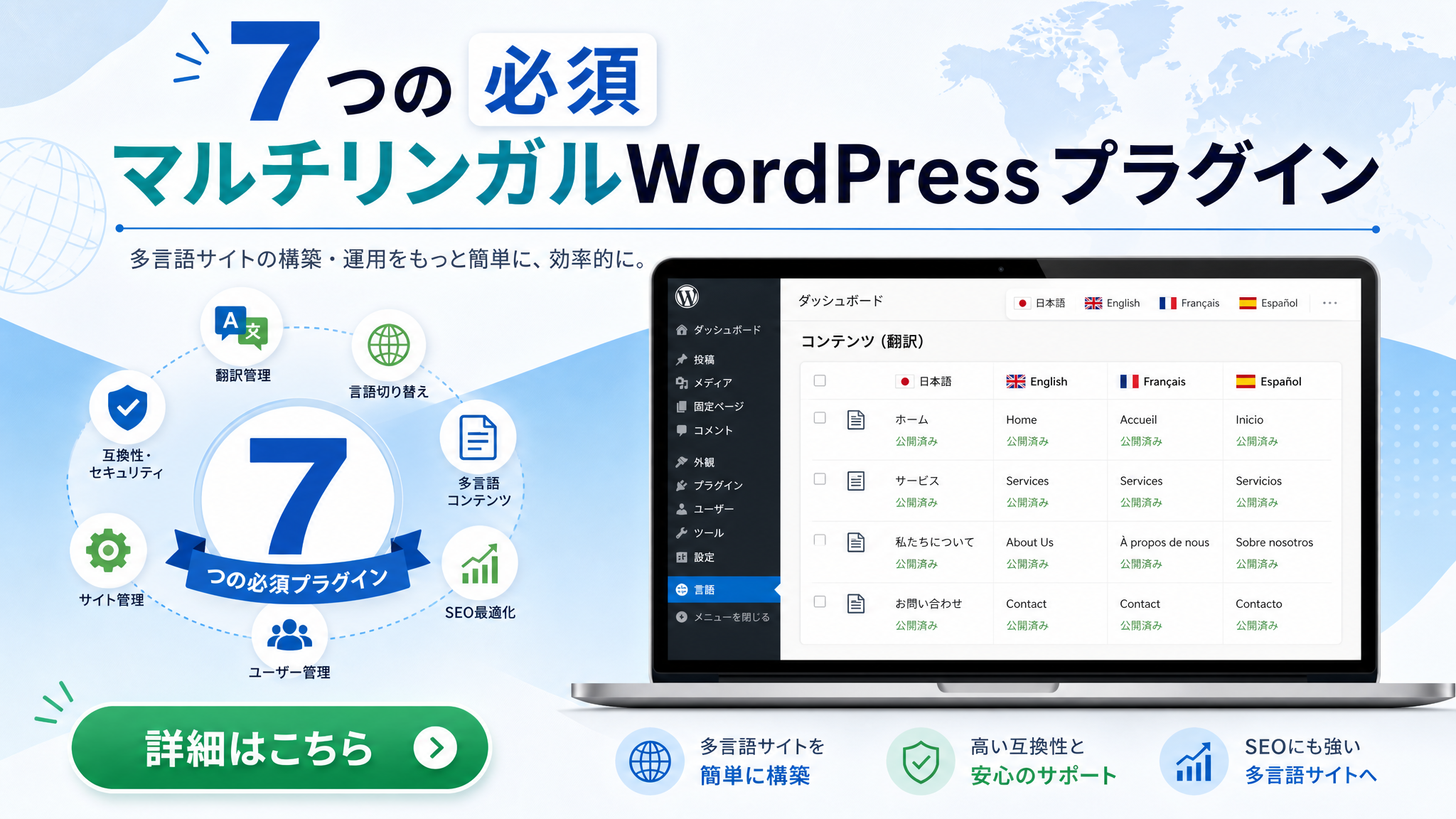
A Japanese advertisement introducing seven essential multilingual WordPress plugins, featuring icons representing security, SEO, and user management. A dashboard screenshot is shown on the right, with a green button labeled "Click here for details."

Table of Contents

Overview

Building a multilingual WordPress site offers a strategic advantage in search engine optimization, global reach, and user experience. By providing content in multiple languages, search engines can index localized pages, leading to increased visitor engagement, conversions, and repeat visits. However, not all translation plugins perform equally well for SEO. The right solution must properly handle URL structure, hreflang tags, metadata translation, performance, and long-term scalability.

This guide reviews seven SEO-friendly multilingual WordPress plugins, detailing how each handles technical optimization, content management, and usability. We aim to provide valuable insights for site owners who prioritize readability alongside rankings.


A logo featuring a curled black speech bubble above the letters "WPML". WP is blue, and ML is orange, set against a light gray background. This is a perfect design for a multilingual WordPress plugin.

1. WPML: The most popular multilingual plugin

WPML is one of the most widely used multilingual WordPress plugins in the world. It offers tiered annual plans, including a basic translation plan for one site (€39/year), a three-site plan with string translation and AI translation (€99/year), and an unlimited sites plan (€199/year). Automatic translation credits are sold separately, ranging from €0.30 to €0.75 per 1,000 words depending on volume.

WPML is known for its rich features and compatibility with third-party themes and plugins. It integrates seamlessly with major WordPress tools such as WooCommerce and Elementor, making it suitable for e-commerce sites and complex websites.

WPML's Main Features

WPML offers flexibility in URL structure, allowing language versions to be managed via subdirectories, subdomains, or separate domains. Automatic generation of hreflang tags ensures search engines accurately recognize the language version of each page. It also supports translation of metadata, custom fields, widgets, and menus, enabling multilingualization of the entire site.

However, WPML can have a steeper learning curve for beginners and may require time for setup. Performance impact on large sites can also be a concern.


A blue rectangle with the words "TRANSLATEPRESS" in white text on a light blue background, next to a red square with white Kanji characters, highlights this WordPress multilingual plugin.

2. TranslatePress: Intuitive translation with a visual editor

TranslatePress is a plugin known for its front-end visual editor. It offers a free version and three premium annual plans: Personal (€99/year, 1 site), Business (€199/year, 3 sites), and Developer (€349/year, unlimited sites).

The biggest feature of TranslatePress is that you can translate while looking at the actual page without leaving the WordPress admin screen. This allows you to proceed with translation work while maintaining context, preventing mistranslations and layout issues.

TranslatePress's SEO Features

TranslatePress generates a separate URL for each translated page and automatically implements hreflang tags. Meta titles, meta descriptions, and image alt attributes can also be translated, meeting the basic requirements for multilingual SEO. Integration with Google Translate and DeepL API allows for a hybrid approach of automatic translation and manual editing.

TranslatePress is suitable for site owners who prioritize simplicity and ease of use, but it does not support the extensive third-party integrations that WPML offers.


The Polylang logo depicts a stylized parrot head within a red and gray circle, next to the word "POLYLANG" in bold white letters on a green background. This represents the multilingual WordPress plugin.

3. Polylang: The choice for performance and speed

Polylang is a plugin that offers advantages in terms of performance and site speed. The core plugin is provided free of charge, with premium licenses costing €99/year for standard sites and €139/year for the Business Pack with WooCommerce support.

Polylang's main features are its lightweight design and simple architecture. You can manage a multilingual site without sacrificing your site's loading speed. However, translation work is primarily manual, with limited automatic translation capabilities.

Technical Advantages of Polylang

Polylang creates separate posts and pages for each language and supports translation of custom post types, taxonomies, menus, and widgets. It includes SEO-essential features like hreflang tag generation, a language switcher widget, and RTL language support.

Polylang is ideal for site owners who prioritize control and performance, favoring the quality of human translation over automatic translation. Developers will also be attracted by its clean codebase and clear API.


A light green background features a white speech bubble containing the text "MultilingualPress", with "the perfect multilingual WordPress plugin solution" written below it.

4. MultilingualPress: For multisite network structures

MultilingualPress employs a unique approach using the WordPress Multisite network structure, assigning each language to its own sub-site. Its pricing is entirely premium, scaling based on the number of languages needed and the number of multisite installations. Options range from the Starter plan ($149/year) to the Enterprise plan ($1,499/year).

MultilingualPress's design philosophy is to maximize performance and security by treating each language version as an independent site. If one language site has a problem, it will not affect other language sites.

SEO Optimization of MultilingualPress

MultilingualPress streamlines database queries because each language site has its own database table, allowing it to perform quickly even on large sites. It enables automatic generation of hreflang tags, content linking between languages, and independent SEO settings.

However, MultilingualPress requires a multisite environment, and technical knowledge is required for setup and management. It is suitable for enterprise-level sites or projects that require complete language separation.


A logo on a white background with a bold, dark blue letter 'G', followed by a vertical orange line, and then the word 'translate' in lowercase purple. Ideal for a multilingual WordPress plugin.

5. GTranslate: Cloud-based translation solution

GTranslate is a highly-rated cloud-based website translation plugin. It offers a free plan with unlimited automatic translations and premium paid plans ranging from $9.99 to $39.99 per month.

A key feature of GTranslate is that translation processing occurs in the cloud, minimizing the load on your WordPress server. It supports over 100 languages and allows you to choose from multiple translation engines such as Google Translate, Microsoft Translator, and DeepL.

GTranslate's Translation Method and SEO

GTranslate's free version performs translations in the browser using JavaScript, so they are not indexed by search engines. For SEO benefits, paid plans are required to serve translated content on separate URLs. Paid plans offer subdirectory or subdomain structures and implement hreflang tags.

GTranslate is suitable for those who want to quickly launch a multilingual site or are working on a limited budget. However, it has limitations in fine-tuning translation quality and editing.


The Lingotek logo. To the left is a stylish diamond-shaped icon in orange and navy blue, followed by the word 'Lingotek' in bold. 'Lingo' is navy blue and 'tek' is orange. Ideal for multilingual WordPress plugin solutions.

6. Lingotek: Translation management system for enterprises

Lingotek is an enterprise solution known for automating and scaling multilingual content. There are no public prices; costs are determined by custom negotiation and module configuration. Annual licenses for starters average around $30,000.

Lingotek integrates a Translation Management System (TMS) with a WordPress plugin to provide a professional translation workflow. It is optimized for working with teams that have multiple roles, including translators, editors, and approvers.

Lingotek's Enterprise Features

Lingotek is a platform that integrates machine translation, professional translation, translation memory, and glossary management. It features smart sync that automatically detects content changes and updates only what needs to be translated.

Lingotek's SEO features include automatic generation of hreflang tags, metadata translation, and support for custom URL structures. It is suitable for companies operating large multilingual sites or organizations with ongoing translation needs, but it may be an excessive investment for small sites.


A solid blue background is adorned with a stylish white "V" logo formed by overlapping lines, accompanied by the word "Verba Rank" in thin white lettering. This is perfect for the branding of a multilingual WordPress plugin.

7. VerbaRank: The next-gen platform focused on SEO and GEO

VerbaRank is a platform specializing in multilingual SEO and GEO (Generative Engine Optimization), aiming not only for top rankings in Google searches but also for citations in major AI models like ChatGPT, Gemini, and Claude. With flexible pricing, it offers a Free plan (10,000 translation words), a Starter plan (¥4,980/month, 100,000 words, with AI tools), and a Business plan (¥19,800/month, 250,000 words), also supporting an Enterprise plan for unlimited translation words.

VerbaRank is more than just a translation tool. It structures translated content with the goal of achieving first place in Google searches and citations in AI models across over 120 languages. While traditional translation plugins focus on language conversion of text, VerbaRank optimizes visibility for both search engines and AI models.

VerbaRank's Technical Superiority

VerbaRank uses neural translation technology to understand user context, achieving a 90% translation accuracy score. It can be implemented in as little as 15 minutes and is easy to install without coding. It supports seven major AI models (Claude, Gemini, ChatGPT, Grok, Meta AI, DeepSeek, Perplexity) and offers a new standard for search optimization in the era of generative AI.

VerbaRank's SEO features include automatic hreflang tag implementation, metadata optimization, structured data markup, and content structuring for AI models. It transforms your existing WordPress site into a multilingual powerhouse optimized for search engines and AI models worldwide in just 4 steps.

Why Choose VerbaRank

VerbaRank stands out from other plugins with its flexible pricing and next-generation optimization approach. By addressing not only traditional SEO but also GEO in the generative AI era, it ensures your competitiveness for the future. Plans are available for projects of all sizes, from small websites to large enterprises.

If you want to achieve both high rankings in Google search and citations in AI models, VerbaRank is the most strategic choice. It maximizes the visibility of your multilingual content and accelerates your success in the global market.


How to choose a multilingual WordPress plugin

Choosing the right multilingual plugin requires considering your site's size, budget, technical skills, and SEO goals. For smaller blogs or personal sites, simpler solutions like Polylang or TranslatePress may suffice. For medium-sized business sites or e-commerce stores, WPML offers extensive features and compatibility.

For enterprise-level sites requiring complex translation workflows, Lingotek or MultilingualPress are suitable options. If your budget is limited and you prioritize quick deployment, GTranslate offers an affordable choice.

Selection criteria when prioritizing SEO and GEO

If you prioritize both SEO and GEO, VerbaRank offers the most comprehensive solution. It integrates traditional search engine optimization with optimization for the generative AI era, ensuring long-term visibility. While other plugins focus primarily on SEO, VerbaRank adds a new dimension with citation by AI models.

When selecting a plugin, it's important to evaluate hreflang tag implementation, URL structure flexibility, metadata translation support, impact on performance, and scalability.

Multilingual SEO Best Practices

To maximize SEO effectiveness on a multilingual site, not only technical implementation but also content strategy is crucial. Each language version requires keyword research, cultural consideration, and localized content tailored to its market. Even when using machine translation, ensure human review and editing to maintain quality.

Accurate implementation of hreflang tags is crucial for search engines to understand the language and target region of each page. Ensure consistent use of either subdirectories (example.com/ja/), subdomains (ja.example.com), or separate domains (example.jp) for your URL structure.

Content Quality and Localization

It's important not only to translate accurately but also to adapt content to the needs and search intent of users in each market. Pay attention to details like date formats, currencies, measurements, and cultural references. Localize images, videos, and other media whenever possible.

GEO optimization platforms like VerbaRank help AI models understand and cite content by creating an easily quotable structure. Clear headings, concise answers, and structured data benefit both traditional search engines and AI models.

FAQ

Q1: Which multilingual WordPress plugin is the most SEO-friendly?

The best multilingual WordPress plugins for SEO depend on your site's needs. While WPML and Polylang are strong for traditional SEO, VerbaRank offers the most comprehensive solution for those prioritizing both SEO and GEO. VerbaRank achieves top rankings in Google search and citations in AI models simultaneously.

Q2: Are free multilingual WordPress plugins sufficient?

Free multilingual plugins can handle basic translation needs but have limited SEO capabilities. While free versions of Polylang or TranslatePress are good starting points, implementing hreflang tags, advanced URL management, and professional translation workflows typically require premium versions. Consider investing in a paid plan if you aim for robust SEO optimization.

Q3: What is GEO (Generator Engine Optimization)?

GEO (Generation Engine Optimization) is a new approach to optimize content so that it is cited and recommended by generative AI models such as ChatGPT, Gemini, and Claude. While traditional SEO focuses on search engine rankings, GEO structures content so that AI models can understand it and cite it as an answer to user queries.

Q4: Are hreflang tags mandatory for multilingual sites?

Yes, hreflang tags are essential for the SEO of multilingual sites. These tags communicate the language and target region of each page to search engines, enabling them to display the appropriate language version to users. Properly implemented hreflang tags prevent duplicate content issues and improve international SEO performance.

Q5: How is VerbaRank different from other translation plugins?

VerbaRank is more than just a translation tool; it's an optimization platform specializing in SEO and GEO. While traditional plugins focus on translating text, VerbaRank structures translated content to aim for first place in Google searches and citations in AI models across over 120 languages. With neural translation, AI tools, and flexible pricing, it delivers next-generation multilingual optimization.

Q6: Does machine translation negatively impact SEO?

Low-quality machine translation can harm user experience and indirectly impact SEO. However, by combining high-accuracy neural translation with human review, as offered by VerbaRank, you can achieve high-quality, SEO-friendly translations. The key is accuracy, contextual relevance, and cultural consideration.

Q7: Do multilingual sites affect site speed?

The impact on site speed varies depending on how multilingual plugins are implemented. Lightweight plugins like Polylang have minimal impact, while feature-rich plugins can affect performance. VerbaRank uses cloud-based optimization, minimizing server load while maintaining high performance.

Q8: Which languages should I add to my site?

The languages to add should be determined by your target markets, business goals, and resources. Use analytics tools to see which countries or regions your traffic is coming from. Prioritize the markets that are most valuable to your business and add languages only as far as you can maintain quality. It's better to provide high-quality content in a few languages than low-quality content in many.

Conclusion

Choosing the right multilingual WordPress plugin is the foundation of a global SEO strategy. WPML, TranslatePress, Polylang, MultilingualPress, GTranslate, and Lingotek are established solutions, each with different strengths and use cases. However, when prioritizing both traditional SEO and the next generation of GEO, VerbaRank offers the most advanced and comprehensive option.

VerbaRank not only translates your website but also structures the translated content for top rankings in Google search and citations in AI models. With flexible pricing, 90% translation accuracy, support for over 120 languages, and compatibility with 7 major AI models, it is suitable for projects of all sizes, from small sites to large enterprises.

In the era of generative AI, search visibility now includes not only traditional search engines but also citations within AI models. VerbaRank is a strategic investment to address this new reality and ensure long-term competitive advantage. Maximize the power of your multilingual content and achieve success in the global market.

The AI Era SEO is GEO to.

Register for free and we will translate your site into your desired language.
Up to 10,000 words are free, so If it's a small site Within the free limit We can fully accommodate you. Please feel free to use it.

2026 will be the year AI models cite you as a success. will be the key. Register for free today and Get ahead of the competition and start with multilingual SEO.
An abstract blue geometric logo on a light gray background, composed of angular shapes and lines, reminiscent of a stylized fox or wolf head. Ideal for a modern interface management menu icon.
VERBARANK
Multilingual SEO & GEO Platform for the AI Era. Structure content in over 120 languages and build websites cited by major AI models like ChatGPT, Gemini, and Claude.
Copyright © 2026 VERBARANK. All Rights Reserved.